
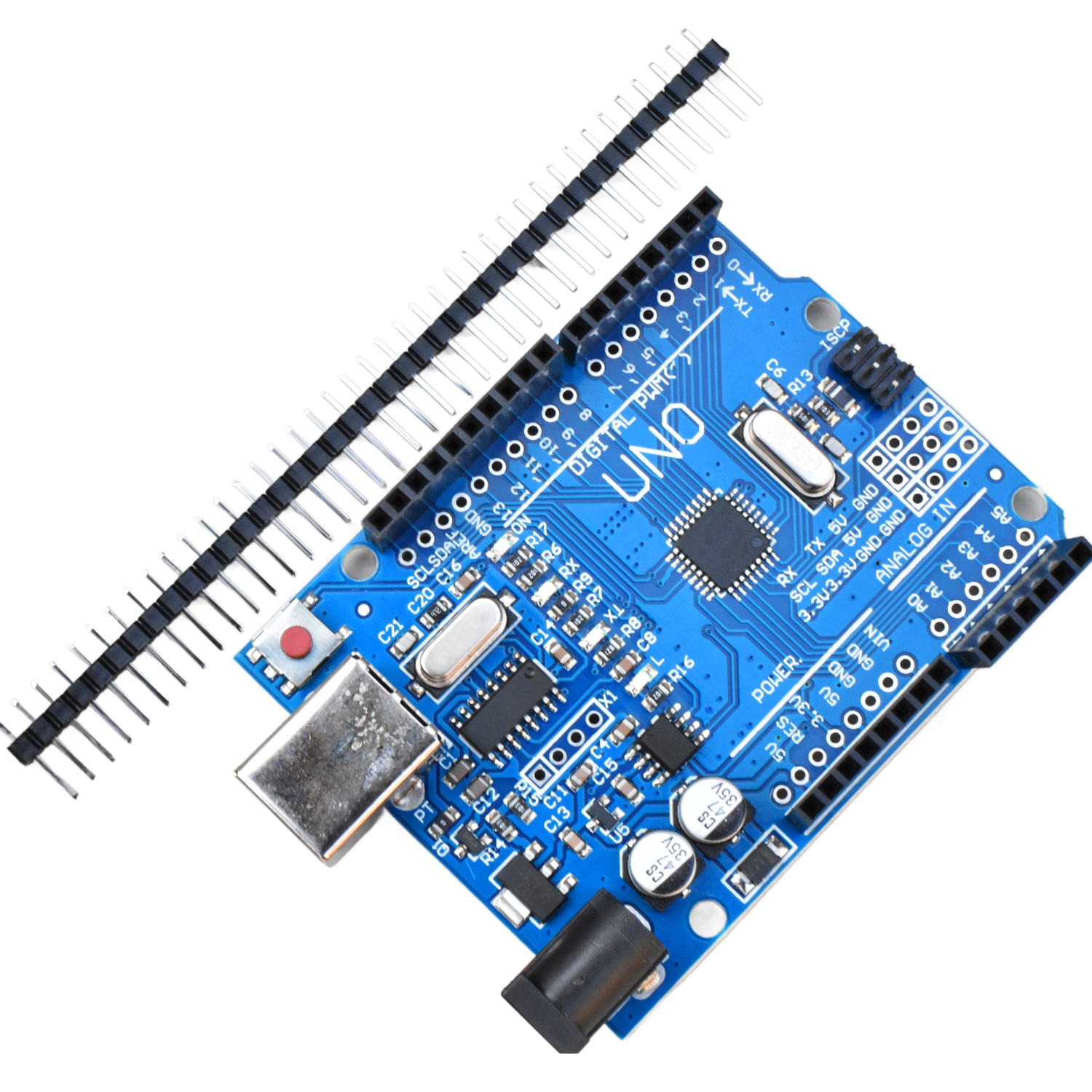
Arduino Uno SMD
The Arduino Uno SMD is a compact variant of the Arduino Uno development board, using surface-mount components. Based on the ATmega328P microcontroller, it offers the same functionality and compatibility with Arduino shields, but in a smaller form factor thanks to its surface-mount design. It facilitates electronic prototyping and project development through its user-friendly programming environment and its input/output pins for connecting various components.
The Arduino Uno SMD is a compact variant of the Arduino Uno development board, using surface-mount components. Based on the ATmega328P microcontroller, it offers the same functionality and compatibility with Arduino shields, but in a smaller form factor thanks to its surface-mount design. It facilitates electronic prototyping and project development through its user-friendly programming environment and its input/output pins for connecting various components.
Specifications:
-
Microcontroller: ATmega328
-
Nominal operating voltage: 5 V
-
Recommended input voltage: 7–12 V
-
Maximum input voltage via VIN: 6–20 V
-
Maximum input voltage via USB connector: ≈ 5.5 V
-
Digital input/output pins: 14 (including 6 PWM outputs: pins 3, 5, 6, 9, 10, and 11)
-
Analog input pins: 6 (also usable as digital pins)
-
Maximum current per I/O pin (5 V): 20 mA
-
Maximum current available from the 3.3 V output: 50 mA
-
Maximum current available from the 5 V output: 500 mA
-
Flash program memory: 32 KB (ATmega328), including 0.5 KB used by the bootloader
-
SRAM (volatile memory): 2 KB (ATmega328)
-
EEPROM (non-volatile memory): 1 KB (ATmega328)
-
Operating temperature: -40°C to 85°C
-
Clock speed: 16 MHz
Note:
The Arduino Uno can be powered either through the USB connection (which provides 5 V, up to 500 mA) or through an external power supply. The power source is automatically selected by the board.
The external (non-USB) power supply can be either an AC-to-DC adapter or batteries. The AC adapter can be connected to the board's 2.1 mm DC barrel jack. Wires from a battery pack can be connected to the board's pins labeled GND (ground or 0 V) and VIN (positive input voltage).
In theory, the board can be powered with an external voltage ranging from 6 to 20 V. However, powering the board with less than 7 V may result in unstable operation, even though it may work at 5 V in some cases.
If you use more than 12 V, the voltage regulator may overheat or become damaged. The ideal recommended voltage range for powering the Arduino Uno is 7 to 12 V.
Applications:
-
Rapid electronic prototyping: Quickly create functional prototypes to test electronic concepts and ideas.
-
Electronics education: Teach programming and electronics in classrooms and training environments.
-
Home automation: Automatically control lighting, heating, security systems, and other household devices.
-
IoT (Internet of Things) projects: Connect physical devices to the Internet to collect data and enable remote control.
-
Robotics: Control movements, sensors, motors, and actuators in various robotic applications.
-
Interactive devices: Create interactive artistic installations, games, toys, and electronic devices.
-
Lighting control: Create automated and customizable lighting systems for different environments and applications.
-
Measurement and sensing: Use sensors to measure temperature, light, and other physical parameters.
-
Industrial automation: Control processes, equipment, and machines in various industrial applications.
-
Consumer electronics: Develop electronic products for consumers, such as controllers, toys, gadgets, and other smart devices.
Similar products
4000 FCFA
17950 FCFA
1650 FCFA
2400 FCFA
810 FCFA
1900 FCFA
1600 FCFA
2300 FCFA
2600 FCFA